Mice vs Men

The most apparent contrast between the two traces that I did is the fact that in my first Maus trace, the people being portrayed are human showing human emotion and on the other hand, in my second tracing of Maus, the Poles are being portrayed as pigs and the Jews as mice.

2018-03-12 02:20:482018-03-12 02:14:42

This contrast is a big one especially when both books are called Maus which is simply mouse in German. Throughout the whole book, the reader becomes accustomed to thinking of the characters in the story like Vladeck, Anja, or art as Mice and not human, and to get to this point of the book and now associate them with human beings sorta creates a wake up call that the events being portrayed by mice through the book, where experiences that where actually suffered by ordinary human beings. This change in the portrayal of characters made me be able to connect more to the moment that I traced. When I saw Artie’s mom come to him and ask if he loved her, I could only picture my mom doing the same thing.  This simply resulted in me crying because I could never imagine myself ever doing that to my mom at this age.

As I mentioned in my analysis of my tracings, It was very hard for me to feel strong emotions during both books. It is clear why it was easier for me to feel more in my first Maus trace but why was I also able to feel as well in the final page of book 2 (My second trace)?

Even tho there aren’t any humans portrayed in the final page, my conclusion was that by Art’s decision to put a tombstone at the very end of the book served as a reminder that we are talking about human beings, just like the first trace did. It reminds the reader that the characters that we were so fortunate to experience through the book were people that had burial like human beings and not like mice which are inexistent.

 

Analyze your tracings

Explain what drew you to the two pages you traced?

What drew me to page 105 and page 296 was my emotions towards them. I am a very emotional person and tend to cry to sad movies or sad books with great ease. Especially with things about the holocaust since it is a topic that is close to me since my grandfather and his family had to survive it. But for some reason, it was really hard for me to feel strong emotions throughout this book. My conclusion is that by illustrating the horrors of this war being done to mice, I figured I could not associate it as well. But page 105 which consisted of the comic that Art did in 1972, and the final page of the book caused me to tear up and feel a great degree of emotion. I picked these two pages because they truly made me feel both happiness and sadness, which were two emotions that were hard for me to feel throughout the whole book.

What did you find yourself leaving out of the tracing? What did you find yourself striving to include in the tracing? Why?

I decided I would try to trace as close as I could get to the book. The reason for this was because I felt that I was under-appreciating the time and effort that goes into each panel. I wanted to have a sense of how it felt for the artist to draw these impactful pictures and for that reason, I tried not to leave out anything.


Tracing Maus Reflection


filip maus 1 trace-page-001 structure 1

Tracing a page of a graphic novel is something I had never done before. I have analyzed dozens of texts for rhetoric, symbolism, etc. but I have never had to analyze a visual representation. It came to me more easily than I thought; I was finding details that I quickly glanced over when I initially read the pages. I immediately found things to write about and the word count was not difficult to reach. On my page I have a landing page that leads you through all of my observations and thoughts on the pages I chose.  It’s extremely impressive to me to take a step back and appreciate the dedication that Art Spiegelman had to this work. It makes me want to read it again with a keener eye.


Tracing Maus Reflection

The writing process for this assignment was a little harder than for previous ones for me. A couple things in this assignment were new for me. I had never traced a comic page before, I found it it can be quite a long process. I’ve never tried writing in close analytical detail of a graphic novel before and when I tried, at first I was lost as to what to say, how extract meaning form a page of drawing. The page notations helped, seeing some notes pointing to the specific details on the page helped sharpen my ideas and I was able to write easier after that. I also have never tried to write three different posts which are supposed to reference/relate to one another simultaneously. The way I approached it was to first write just about the idea at hand and then once I had finished all of the different pages, when I had was editing, I would add connection points to each. The annotated pages really helped here because I was able to see visually how the ideas all connected so it made writing about it easier. Overall I think it was a challenging assignment but one that I learned a lot from and had a lot of fun doing.

Tracing Maus Reflection

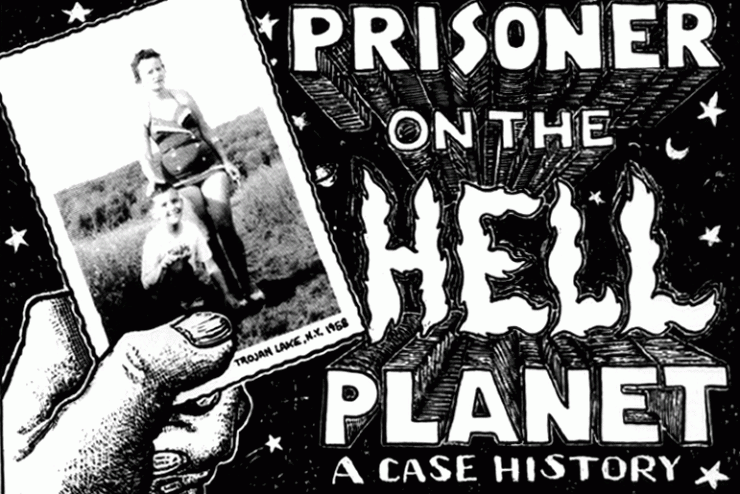
mausprisoner.gifTracing Maus was very interesting in that it took several elements to completely analyze two pages from Maus. By having it broken down into stages, I felt that I got a better understanding of what was going on within those pages because I was able to look at them from different perspectives.

By first having to trace the pages, I had to see what visual elements from the original comic were relevant to the story telling and thus had to make a preliminary visual analysis of what I was seeing. Then, by having to analyze the tracings according to Scott McCloud’s definitions, I was able to further pinpoint certain segments of the page that make the storytelling work. Finally, by having to compare and contrast the two pages to form arguments, I was able to see how certain elements evolved over the course of the two books.

The Importance of Feelings

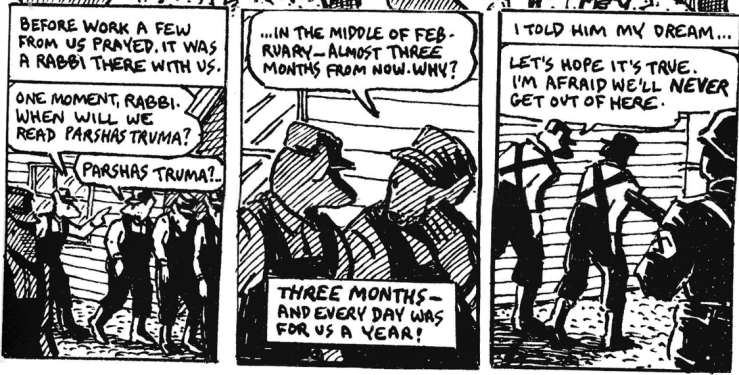
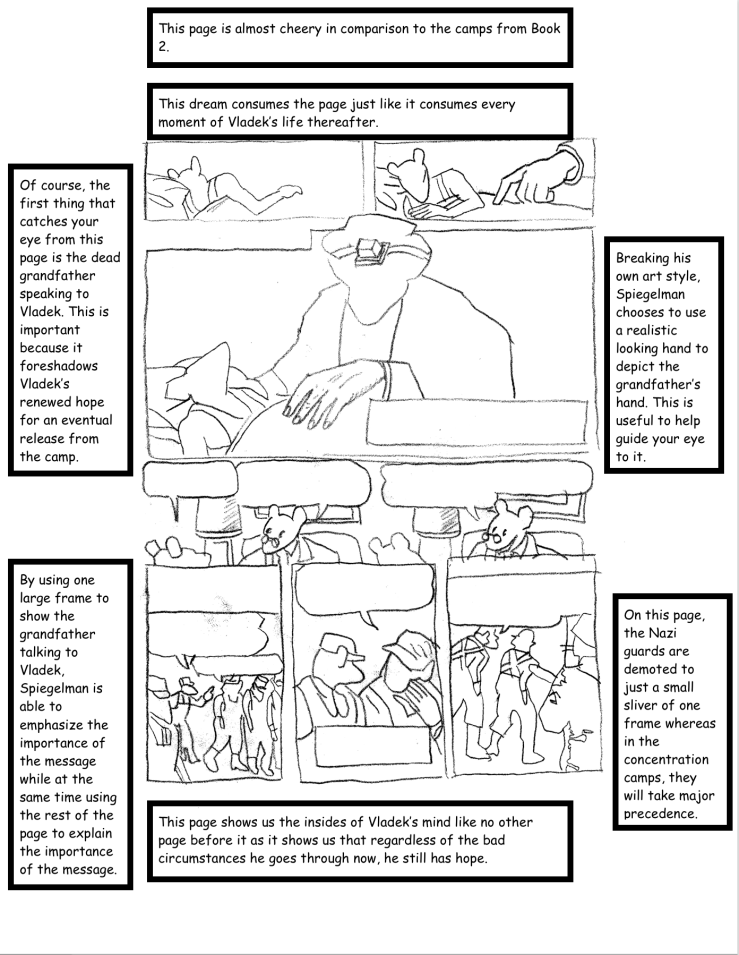
In book 1, we mostly get a vague picture of how Vladek was feeling during the time of the war, but we rarely get any information on how Artie is feeling, beyond just general frustration with his father. However, both of these two things shift as we progress later on into the story. Both Artie and Vladek experience moments in the book where they open up either to each other or to the reader specifically. The “Parshas Trauma” moment in Book 1 is the first real instance where we get a glimpse into Vladek’s feelings, although this revelation isn’t too profound. Screen Shot 2018-03-07 at 11.05.03 PM.png

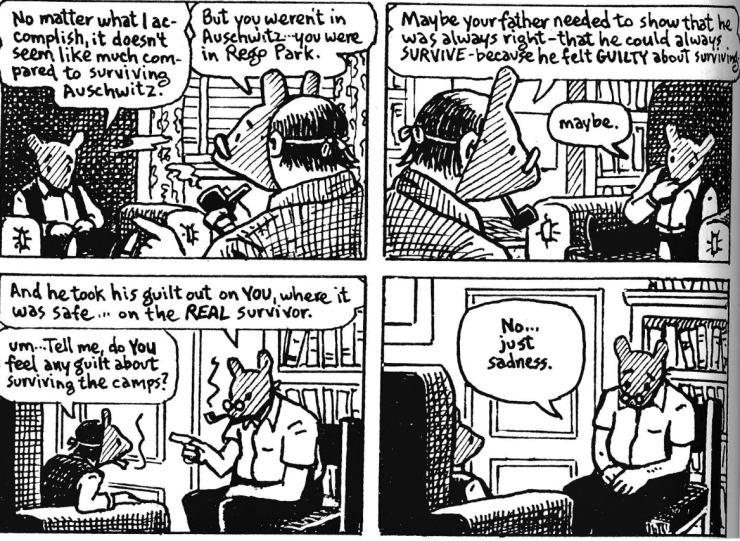
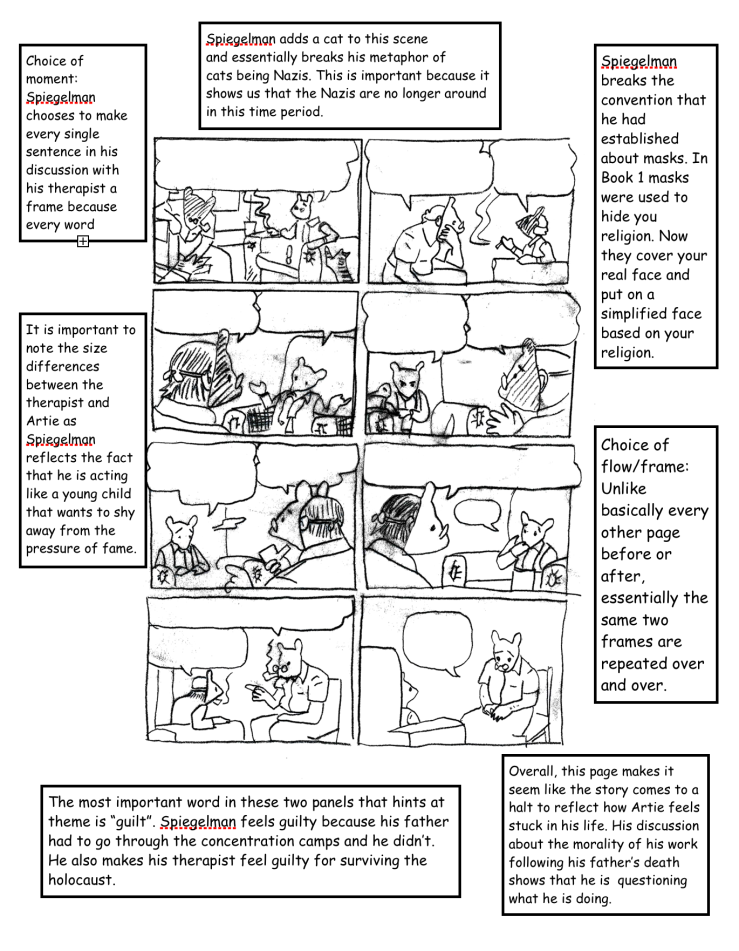
However, in book 2 we learn that Art has started visiting a therapist to help him deal not only with the pressure of his father’s death but with the mounting fame and pressure coming from the release of book 1. We get a glimpse into the mind of Art and how the concentration camps affected him even though he never lived through them. Almost 43 years later, the camps were still taking a toll on many people, Art included. Art is struggling to cope with the information left to him by his father. He blames himself for not having gone through the camps and not understanding his father, and the therapist explains that his father may have taken out his on guilt on Art to help cope with what happened. Vladek felt guilty for surviving the Holocaust, and takes it out on Art, who then takes it out on his therapist. This progression of guilt taxes Art heavily and takes a toll on his wellbeing. Screen Shot 2018-03-07 at 11.08.05 PM.png

1 … 12 13 14 15 16 … 26