Peer Feedback and Rough Draft

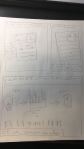
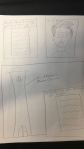
The main point that all of my peers made is that there should be less panels of essays and more creative pictures. What they agreed upon is that they liked the idea of having my panels be metaphors. They also found the tone to be dark and satirical which I found hilarious because I had never considered my tone to be that but it is very accurate.

Collin Combs Sketch and Reflection

BE41A79E-8E11-401E-A144-F990E3BE5979


I was drawn to this image because the man in the picture was throwing something.  I first noticed that he was not throwing something that was meant to traditionally be thrown.  Also, he is in a parking lot of some sort.  For me drawing, however, I decided to focus on just the motion of the guy and the object he was throwing.  While I was sketching the image, the mans taught shirt was what I began to notice the most.

Colin Combs sketch

As I spent time sketching for this assignment, I started noticing that it was much easier to sketch it than I thought before. The peacefulness and calmness that we can feel from looking at the picture are what made me pick this photo. At first, I thought that I will sketch everything that I see. However, as I was drawing I decided to sketch only what is in the focus, not blurry backgrounds due to the fact, that I wanted to make an even greater focus on simplicity of the moment and on the fact that if a person is asleep all she needs in this most unprotected moment is calmness.

FullSizeRender

Photo: by me

Sketch 7: THAT Back Corner

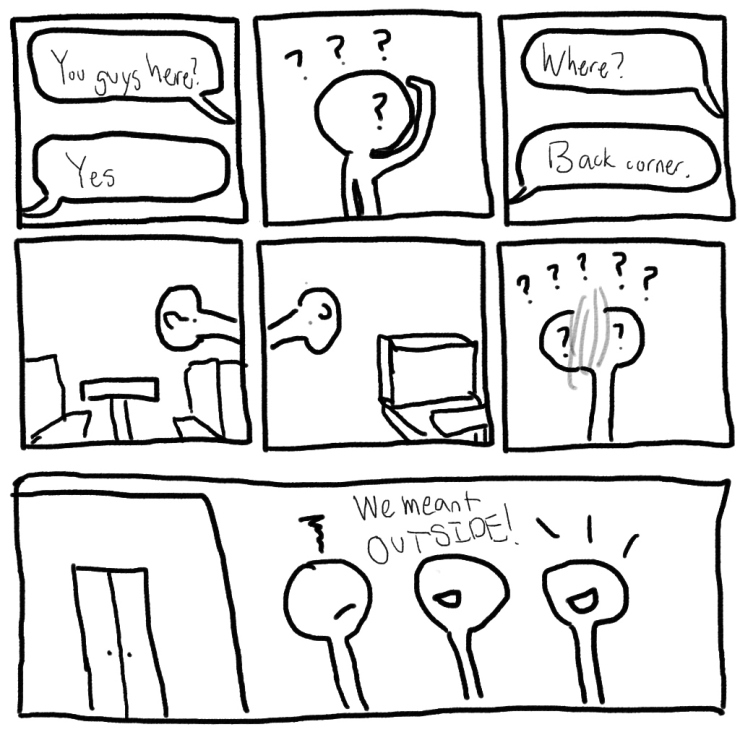
eng101s18sketch7

This comic was a funny moment in my spring break, hanging out with friends. But I realized it also could have a deeper meaning to it.

I decided I would grab dinner with a couple of my friends, as I’d missed them a lot and hadn’t seen them for a while. We arranged a time to meet up, and I showed up about 5-10 minutes late. I was worried they’d already started to eat, so I texted one of them and asked if they were inside. A quick reply told me they were here. I checked around initially, asked where specifically they were, and continued the search. After a bit, I came outside to call, and I discovered they were sitting right outside on the bench. Then, they joked with me that it was “outside back corner” that they meant. I wasn’t actually upset at them (I’m used to their shenanigans at this point), but I drew it that way in the comic because it felt more conclusive.

I knew this was the right story because it teaches a valuable lesson. It teaches the lesson of perspective and how it can affect things. While it was true that they were in the outside back corner, I had assumed they were inside of the restaurant in the back corner. But, of course, I had assumed the logical path and didn’t even consider the illogical path. But life isn’t logical. At least, not always. There have been many things that have happened in my life, and likely your life, that have made us think: “That doesn’t make sense.” Perspective and logic are two things that are, sometimes, taken for granted, and we don’t seem to account for the idea that things don’t always go one certain way.

It’s actually quite difficult to tell a true story in a short comic. Most “truths” or “events” go well beyond a simple single-digit panel event. So to find something to condense into a short and sweet comic is absolutely difficult. Especially when you are attempting to find some “truth” in it. With the two poles of a spectrum being Spiegelmann and Sacco, I imagine that this story falls more on the side of Spiegelmann. It tells the perspective of a decently truthful event without too much bias, similar to the style of Speigelmann’s Maus.

While creating this comic, I had to decide the style and panel formation that I wanted to go with. I decided on a big panel for the last punch line, as I feel that would amplify it that much more. I decided on a more stick-figure like format for the characters because I wanted it to be simple. But I also wanted to experiment with expression on stick figures and without faces. I’ve seen it quite a few times previously, and I really wanted to try it out. I think it turned out okay, but I might go back to drawing faces; it’s easier for me, even if my faces are terrible.

Class Cancellation Sketch: Colin Combs

eng101s18class_032018

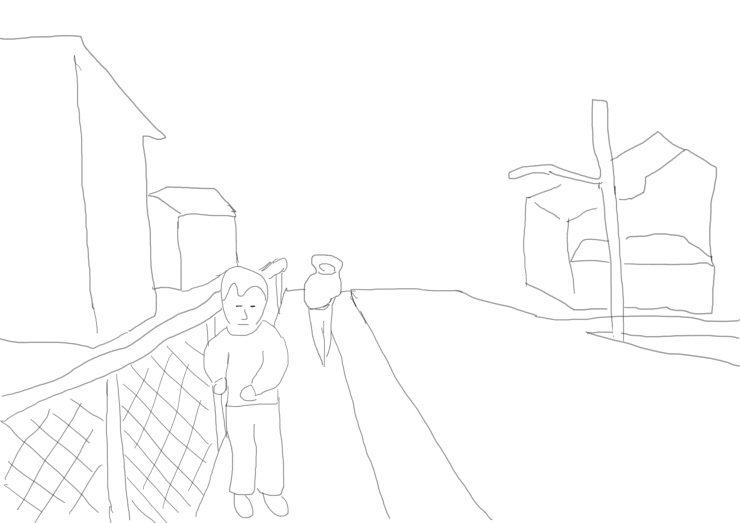
This image had a strange aura to it. It was blurry, it was rainy, and it was moody. But it just looked so peaceful at the same time. Rain is both so overpowering, yet so refreshing. It causes destruction, yet also can be peace. I’ve always loved and hated the rain, and it was the biggest element that drew me to this picture.

As I spent more and more time with the photo, I began to notice more of the subtle things. The facial expression of the person in front. The posture of the person behind. The slight angle of the photo. The condition and structure of the houses. All these things start to gain more and more clarity. I felt like I was really there, having to rain through the rain. The blurriness adds so much more.

The fact that these photographs are not created professionally doesn’t surprise me. There’s always been a certain charm to photos that are simply taken in the moment. They’re sloppy, and in the eye of a professional, I’m sure they aren’t very good. But knowing that someone simply wanted to capture the moment is so amazing. There is no other major reason behind it. No want of money, fame, or anything else that ruins art. It’s just art for the sake of art. Art for the love of art. Art for the beauty of art.

I hope these types of art forms continue on as time continues. This is what true art is. Passion.

Literacy Comic Narrative Feedback

Click to view slideshow.

Personally, I wasn’t a fan of the draft. It wasn’t the message I wanted, it connected things differently than how I feel, and it didn’t portray the right emotions.

This is evidenced by the feedback I got. Without words, a lot of the interpretation of this comic is so up in the air. For example, the tone is assumed to be friendly and comedic, but I had intended for it to be a darker story with hopefulness. While there is one scene of comedy and friendliness (hence the assumed tone is not out of nowhere), I don’t want for that to be the overbearing feeling from the story. In the same fashion, I wanted for the theme of the story to be that writing has saved me. However, because of the lack of words and the poor connection between a lack of reading turning into a plethora of writing, it is assumed that the theme of the story is about reading. This I also don’t want. One piece of evidence that worked against me was the poem I placed on the OPTIONAL first page. This was supposed to be a symbol of my writing career, however, because of lack of specification, it is now assumed to be a symbol of my reading career. While my variation in camera angles, frames, distance, and such are all decent, the overall message of the story is way off when comparing true meaning and interpretation. This is something that needs to be adjusted and fixed ASAP.

And, of course, hopefully words can fix that too.

Tell A True Story

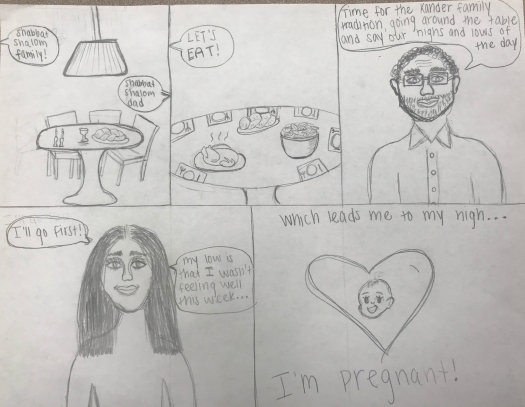
IMG_4007

At my family’s shabbat dinner, my sister in law announced that she’s pregnant! Choosing to write about this story was pretty easy, because it’s a pivotal event in my families life.  I found this story challenging to draw and turn into a comic, because I had to adjust the story slightly in order to make the story clear and cohesive.  For example, she was actually the last to tell her “high and low,” but I wasn’t going to share everyones highs and lows before getting to the key part of the story. An important choice I made in creating the comic was making the bottom two frames bigger than the rest because those are the more dramatic and significant parts of the narrative.

Colin Combs Sketch

IMG_4006

I was drawn to this image, because I’ve always been fascinated by the idea that cameras can’t always capture what we see.  As much as I wish I could capture a moment and save it to my camera roll, I like the fact that some things can only be seen with my own two eyes. I recently went to a concert and whipped out my phone to take a video of the song and the performance.  I later looked at the video and noticed a sea of phones doing the exact same thing.  So much of this new age, iPhone centered, culture is about taking videos and pictures to keep or share.  But I’m starting to realize that these moments are being lived and seen through my phone and not by me.  As I spent time sketching this photo, I noticed that the girl is taking the picture of the fireworks, but the visual doesn’t pan out or replicate what she’s probably seeing.  I also noticed that the picture itself couldn’t capture the entirety of what was going on (the specks of light in the middle and the fireworks on the bottom).  However, what makes this photo “art” is the idea that you can interpret the image as you please.  Things and moments don’t have to be as they appear, otherwise there’s no room for imagination.

Literacy Narrative Feedback Reflection

In drawing out my literacy narrative comic draft, I tried to focus more on the text rather than the pictures. I tried to get the story down before I started creating very detailed drawings. My peers seemed to appreciate that by telling me “it was well written” and “light-hearted” much like I felt the original narrative was. However, I will definitely take their suggestions in my editing process. I will add some more detail and formulate a good conclusion for the end. I also want to put some variation in with panel shape and focus angles on my characters. In all, I felt like this peer editing process was really helpful in seeing what I should and should not change about my comic based on what I saw in the other ones that I read.

Reflection on Tracing Maus

Getting the initial ideas for this project weren’t the main difficulties. For me at least, the ideas came freely. The two main difficulties seemed to be in the fact that the project is so spread out and untangling threads connecting the three ideas to make them distinct. I felt like I had a lot of things to say about these pages, but it was hard to draw a line between some of them due to the interrelatedness of the ideas.

The act of tracing the pages made me respect Spiegelman for the sheer amount of time alone taken to draw the pages, not including the planning of the individual pages or even considering the role of those individual pages in the larger storyline.

Overall, I think this gave me a better appreciation as to the thought that goes into posts that are online. I think I have also become more attuned to the ways webpages are set up to make them more easily navigable. I guess I had never really noticed when there was good design to a website, but I distinctly felt it when a webpage had poor navigation.

Link to Tracing Maus

1 … 6 7 8 9 10 … 26