
The Most Important Panel in Maus: Chapter 3

This rectangular panel, stretching across the entirety of one page, contains Vladek dragging Jan, the soldier that he killed, in the woods to the truck with the other injured German Nazi soldiers. It is found on page 50 of Maus I. It’s relatively small vertically, however. In this panel, Vladek seems to be making a face of effort as he drags this large soldier, while the soldier somehow looks menacing while being dead. There is no dialogue in this panel, but rather Vladek thinking to himself that “at least [he] did something.” What makes this panel so important is the shift in how the rest of the story’s tone and atmosphere will be shifted to a more darker phase. While there will still be small joys, the majority of what is to come is dark. Vladek believing that “at least [he] did something” is somewhat disturbing, making it sound like he did something more causal than to shoot someone.

In Class Writing on Chapter 3 Panel

The rectangular panel takes up about a quarter of the page and shows Vladek being visited by his grandfather while he is sleeping.  It depicts his grandfather exclaiming that Vladek will be freed on the day of Parshas Truma.   Vladek was captured by the Nazis and put into a work camp.  Eventually, on Parshas Truma, Vladek was brought to a significantly nicer facility and ultimately allowed to stay with his friends thereafter.  This is important because his grandfather visiting him gave him a beacon of hope.  At the work camp, Vladek had very little; all he could hold onto was hope.  This is so salient, as this got him through the ordeal and hardships.  Surely, the concept of hope got Vladek, and many others, to keep faith throughout the Holocaust.

Maus Chapter 3: Prisoner of War

At the bottom of page 50, a long, rectangular panel showing Vladek as a young soldier carrying a deceased German soldier caught my attention. In this portion of the narrative, Vladek had told Artie about the first time he was in battle. He was told by his superiors to just keep shooting and to hide himself among the trenches. Vladek, in the midst of battle, ended up shooting and killing what looked to him as a moving tree but was actually a soldier on the other side of the lines. Vladek picks up the soldier and although initially he was shocked that he killed someone, in this panel, it is revealed that he tells himself “at least I did something” rather than just protecting himself. This line sets the scene for the rest of the chapter when Vladek continues to do things in order to help himself. He signs up to work to level out the hills, and although this is very rigorous, it gets him out of the camp and into better living quarters. After working, he is moved to another camp in Lublin when he thinks he has gotten released, yet again, he helps himself by claiming Orbach as his cousin and leaving the camp once again.

Morning free write

Screen Shot 2018-02-08 at 10.11.18 AM


The last panel of page 54 is the most important one because it changed the chances that the main character had in surviving. He was currently in a concentration camp to a minor degree with very little food and shelter. When he saw that there was an opportunity to go somewhere that had more food and a warm bed he knew he had to take it. I don’t think that he would of had the chance to escape like he did in the latter chapter if he would of remained in the camp so I picked this horizontal panel as the most important one because it changed the situation for the main character.

Maus: Chapter 3- Prisoner of War

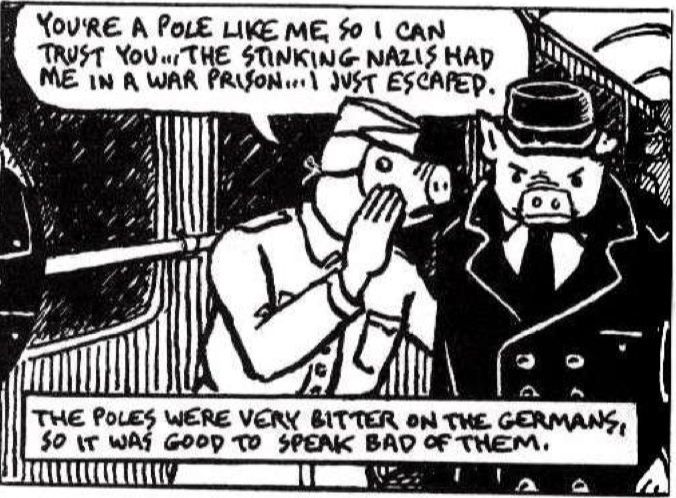
In the third chapter of Maus, there were a few panels that really jumped out at me. The most intriguing one, in my opinion, was one in which Vladek was trying to board the train back to Sosnowiec. The panel is rectangular in shape, about medium size, and very dark. This panel really caught my attention because Vladek is wearing a pig mask to blend in with the Poles. He is speaking badly of the Germans, and using this commonality to worm his way to a spot on the train. I think it is really interesting how Spiegelman portrayed this moment as Vladek wearing a mask, instead of being a “mouse” and attempting to board the train. I think it helps show how much the Jews had to grovel to receive any kind of kindness from anyone in Eastern Europe.

Maus Panel Writing


Screen Shot 2018-02-08 at 10.10.35 AMPage 64 Panel 3

The panel is rectangle that follows a round panel.

Vladek is trying to convince a polish train man to help him get home from the war.

What makes the panel important to me is the fact that Vladek’s character turns into a pig in this page exclusively. He pretends that he isn’t jewish but rather just polish and thus tries to win the train man’s favor. It also looks like he is wearing a pig mask which is symbolic of the mask he put on to hide the fact that he is jewish. The help from the train man is what allows Vladek to return to Anja and his parents so this panel is very important in terms of the overall plot because of difficult his journey would have been otherwise.

Visual Note Taking Reflection

I found the process of visual note taking to be interesting, yet very time-consuming. I initially enjoyed the process because it was different and less monotonous than conventional note taking. Though, I did eventually find the process to be rather tedious because I tend to be a perfectionist with drawing and coloring (even though my drawings are far from perfect). To my surprise I discovered that when I draw and process concepts visually, I remember them better. I learned about memory consolidation in one of my Psychology courses and was told that memory can be enhanced by multi-sensory interaction with a stimulus. And this experience proved that that theory is absolutely true!

Visual notes

I’ve always been a more visual learner so this experiment was pretty fun and helpful for me. I chose to illustrate my Classical Mythology notes which was an amazing choice considering that there’s a lot to illustrate. I had a lot of fun trying to convert the bullet points into images, especially the mythical points because it allowed me to be more creative. I tried to emulate different cartoon/illustration styles and tried to get out of my comfort zone which I believe I did. I didn’t layout the page well and trying to find a flow in the images was harder than I thought it would be. It was challenging trying to push myself to be more creative and trying to get all of the notes on one page. The visual notes helped me internalize the names and stories I needed more than the short-hand notes I used as the basis of this assignment.

SKETCH 2: VISUAL NOTE TAKING

english hw 2sk2

I didn’t know a lot about the memory palace that we looked in Psychology. It allowed me to learn of a new way to memories a lot of information as I displayed in the image and with the text. I created a palace and connected it to the story I wrote. Cicero was the one who invented the memory palace. I said how he would talk to clever hans which was a horse that a scientist tried to prove he could speak languages. But in reality he could only pay attention to small details that would allow the horse to respond because he didn’t actually know what people where saying. It was a great way to learn my material a lot better but it does take a lot of time.

1 … 32 33 34 35 36 … 40