
Objectivity and Rationality: One’s Best Resource

Spiegelman also shows throughout Maus that objectivity and rationality tends to be the best resource in times of distress. The living, breathing example of this in the novel is Vladek himself, who displays incredible ingenuity and resourcefulness in such deplorable conditions.

However, a notable example rises in page 64 of the first book, where Vladek passes off as a Pole in order to board a train and escape to Sosnowiec. In order to ensure his escape, he swallows any type of pride or subjectivity that obliges him to identify as Jew and does what is necessary to get himself on the train. He was objective, and he obtained his desired outcome through the most rational action possible. Conversely, if he had identified himself as a Jew and not “falsify” his ethnicity, he would have been sent back to the camp in a heartbeat.

Another example where Spiegelman hints the idea of rationality and objectivity as the best resource at times of need is in page 29, where an interaction at Auschwitz between Vladek and Mandelbaum, a very rich man from Sosnowiec. Mandelbaum had gotten the short end of the stick at Auschwitz and received ridiculously mismatched shoe sized, lost his spoon, and was given an obnoxiously large size of clothing. He asks Vladek for a spoon, but Vladek, in order to avoid both of them a beating from the guards, does not give it to him at the moment; Mandelbaum proceeds to crumple in a corner and plead to God for help. This is a moment of relative irrationality, because his best course of option at the moment is to actively continue to search for what he needs… even Vladek acknowledges at the end, that in such conditions, God would not help them, and that they were on their own.

This shows that Spiegelman believes that regardless of the existence of God, one must be rational and objective at all times and take the best course of action to satisfy one’s need. Mandelmaum’s need is eventually satisfied, but if it weren’t for Vladek’s thoughtfulness and generosity, he would have never been able to satisfy his need for a spoon and shoes.

Regardless of one’s position, identity, or status in life, it is rationality and objectivity which takes an individual to the optimum decision and the best odds of success at satisfying one’s needs.

Ethnic/Religious Heterogeneity is Irrelevant

This might be a rough start for this assignment; a loaded statement with multiple possible interpretations. Don’t worry, I’ll explain:

Art Spiegelman develops a metaphor throughout both parts of Maus, where different animals represent different nationalities/ethnicities (ex. Mice represent Jews, Pigs represent poles, Cats represent Germans, etc.). We discover that this is a deeply engraved metaphor, and not the novel’s objective reality in page 64 of the first book, where Vladek passes off as a Pole by wearing a pig mask in order to board a train and escape to Sosnowiec.

In the illustrations, it is clear that Vladek, a mouse, is wearing a pig mask, and easily manages to convince the Polish trainman (a pig) of his false identity by bonding momentarily through their mutual dislike of Germans. If the book’s objective reality were to be that of different animals representing different nationalities/ethnicities, then the Polish trainman would have easily caught on to the fact Vladek was wearing a mask, which was made very obvious in the illustrations. This being the case, it is safe to assume Spiegelman is trying to communicate a very relevant message through this animal metaphor.

Given that a mouse passed off as a pig, reason tells me Spiegelman is implicitly stating that nationality or ethnicity is a relatively irrelevant way to classify and identify individuals. A well-crafted performance and presentation from a mouse led him to be identified as a pig by an actual pig; in literal terms, nationality is a construct that is irrelevant when assessing the subjective value of a life, as it is a personal variable that is malleable and misinterpretable to a certain extent.

If one were to be placed in a room with 10 individuals of different origins, it’d be nearly impossible to distinguish their nationalities/ethnicities; A Jew can pass off as a Pole, a Nicaraguan as a Guatemalan, a Brit as an Argentinian. In the end, this relates to the overarching idea that no matter where we come from, where we are, and we’ll be, we’re just humans after all.

Sketch 6

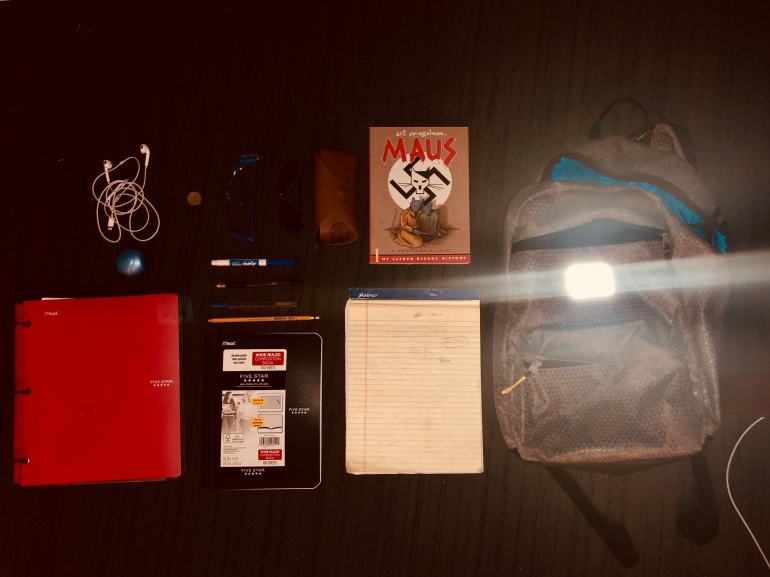
IMG_1010This image is the cleanest representation of my backpack’s contents. It’s usually a mess of papers stashed and crammed along notebooks and my trusty note-pad. I’m a big fan of notepads: being a disorganized person, having an outlet to simply write down anything I need to at the moment is just ideal; it also plays the role of being my math notebook.
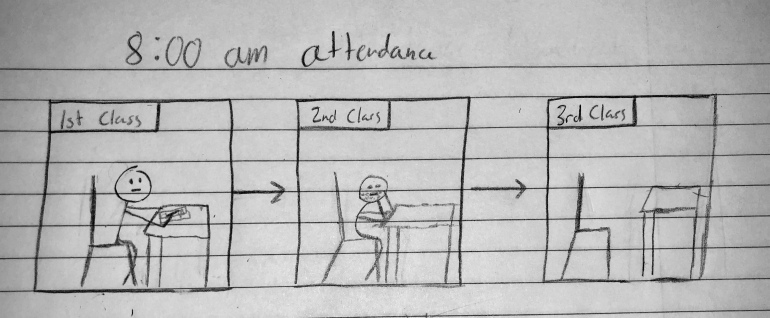
Before taking this picture, I had no idea it’d be a task I get into that much. I spent a considerable amount of time rearranging all the objects into the ideal position for a nice picture. Although I lack talent, it sure was interesting to have an inner drive to display the contents of my backpack in a way that felt aesthetically pleasing.

This exercise also helped me discover my backpack’s logo, when assaulted by a camera’s flash, gives off a strange refraction of light when seeing the picture. The effect can only be seen in the picture, and surprisingly not in person. The more you know…

Today’s Quotes: In Class Free-Write

Richard McGuire’s Here is a very complex comic to follow compared to “Maus”. Given that comics, as said in “Why Comics”, “involves a substantial degree of reader participation to stitch together narrative meaning”, the complexity of the panels is positively related to the degree of focus and dedication one must have to the text. In the case of “Maus”, time changes tend to be relatively frequent, but are introduced in a relatively simplistic fashion, not changing time-frame more than two times in one go; however, “Here” presents multiple time frames in the span of just a few panels, and at times, two completely different and unrelated timeframes in a singular panel. “Here”‘s overabundance of timeframes also, in my personal opinion disrupts the comic’s “‘all-at-onceness,’ or its ‘symphonic effect'”, because I am not able to derive much sense of the comic by analyzing its general picture before starting to read. However, in “Maus”, glancing over the page before reading it and admiring its ‘all-at-onceness’ gives you a general sense of what’s to come, preparing your mind to read the text.

The chicken messed up…

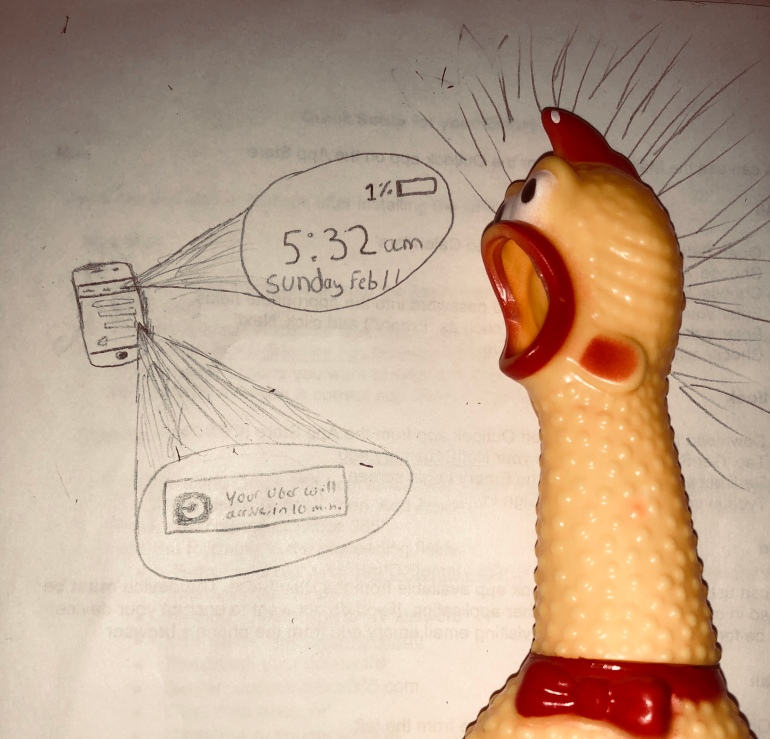
IMG_0585

A scared, lonely chicken seeing his phone is at 1% outside a G-Tech apartment complex at 5:32 am is the perfect description of my last night out. A series of unprecedented events led to me almost having to walk miles and miles through rain and cold in order to get to my dorm. It started like an ordinary night out, which turned to a scavenger search for the friend I swore I’d go back to Emory with. I lost them in Gold Room a popular club in Atlanta, and as the night progressed, and the club closed down, I was forced to look for them not only outside the club, but in the apartment complex we pregamed in. A couple of hours into the search, my friend told me he somehow (and inexplicably) managed to get to Emory. Knowing my friend was safe now, I hit up an uber to take me back home after such a perilous night… I did not expect for the uber to take so long, and my phone to be at the brink of death; the fact that my inability to get to Emory relied solely on the 1% of battery left on my phone instantly made me a chicken, hence my expertly crafted drawing.

Maus Chapter 3: Most Important Panel

As I reas the third chapter of Maus, I came across a panel that completely redefined the entire comic for me. It is the second panel in page 64. In it, Vladek describes how he had to convince a Polish train man to hide him inside the train so he could make it back to Sosnowiec and see his family again; he emphasized that he could not let the Pole know he was Jewish. In this particular case, it is not necessarily the textual content of the panel but rather the image depicted: in it, Vladek is depicted to be wearing a pig mask as he talks to the Pole trainman (poles are depicted as pigs), and through their mutual dislike of Germans, the Pole helps Vladek and sneaks him into the train. The significance of this is that in this graphic novel, the animal forms of the various nationalities are just a metaphor, and nothing else relating to the comic’s reality. If the different nationalities where actually differentiated by animal race in the novel’s reality, the Pole would have easily found out Vladek was a Jew.

1 2 3